
In Belgium, 66% of soils show degraded biodiversity. The use of imported fertilisers intensifies soil pollution and creates a self‑reinforcing cycle. Efforts to maintain agricultural yields increase reliance on unstable supply chains in a tense geopolitical context.
Polluted soils weaken agricultural productivity
Soil biodiversity is essential for plant development and agricultural performance. It supports key ecosystem services such as nutrient recycling, water regulation, and plant resilience. When biodiversity declines due to factors including pollution, crops become more dependent on external inputs such as fertilisers.
-
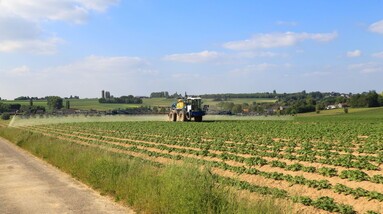 Application of agricultural inputs on farmland in Belgium.

These fertilisers are used to boost short‑term productivity or offset declines. At the same time, these inputs increase soil pollution. Over the medium term, this leads to reduced productivity and weakens the agricultural system.
Fertilisers rich in heavy metals exacerbate soil pollution
In response to productivity pressures, Belgium relies on imported fertilisers. These often contain persistent heavy metals such as cadmium, which accumulate in soils. This further increases pollution and reinforces the vicious cycle described below.

Strong dependence on imported fertilisers
Belgium has no domestic phosphate resources required for certain fertilisers. It therefore depends entirely on imports, including from the Maghreb region such as Morocco. Some raw materials sourced from North Africa contain higher levels of heavy metals like cadmium. Once applied, they increase soil contamination levels.
The European Union has reduced imports from some countries for geopolitical reasons, leading to a reconfiguration of supply chains. Tensions, including in the Strait of Hormuz, have pushed countries that sourced from Gulf states to seek alternatives such as North Africa. This trend increases competition with the EU for fertilisers. Prices rise and supply chains become more fragile.

As a result, Belgium is exposed to geopolitical, economic and logistical disruptions. The country becomes strategically dependent on conditions it does not control. This structural vulnerability extends beyond agriculture and affects national security.
Recommendations
Belgium needs to adjust its approach to reduce this dependency. CERAC proposes the following recommendations.
Restore soil health
- Reduce the use of chemical fertilisers
- Promote agroecological practices
- Strengthen knowledge and protection of soil biodiversity
Reduce dependence on imported fertilisers
- Improve monitoring of soil health
- Develop alternative fertilisers, such as green ammonia and circular fertilisers from organic waste
- Diversify supply sources
Expand scientific research on soil biodiversity and its sensitivity to synthetic inputs
Conclusion
Soil degradation is now recognised as a direct threat to food production and agricultural resilience.
Belgium faces a dual challenge that affects both agriculture and national security
- Imported fertilisers contribute to soil degradation and biodiversity loss over time
Their use increases dependence on unstable and unpredictable supply chains in times of geopolitical tension
Protecting and restoring soil biodiversity is essential for sustainable and resilient agriculture. Healthy soils support stable food systems and reduce dependence on imported fertilisers. Without healthy soils, no agricultural or supply strategy can remain sustainable.